The procurement request that sounds simple (but isn’t)
“Can you reduce the green by 5%?”
For many procurement teams, that sounds like a reasonable request. In industries such as printing, coatings, or textiles, color can often be adjusted in small increments and reproduced with high repeatability.
Mass-colored glass works differently.
In glassmaking, color is not a linear dial. Even when the same recipe is used and process controls remain stable, slight batch-to-batch variation is normal—especially for certain greens and other complex tones.
The challenge is not whether the factory can adjust the color.
The challenge is defining exactly what “5% less green” actually means.
In glass, “5% less green” is not a controllable variable—it is a visual outcome.
In most cases, it describes a visual preference rather than a measurable specification.
Why Glass Color Is More Complex Than It Looks
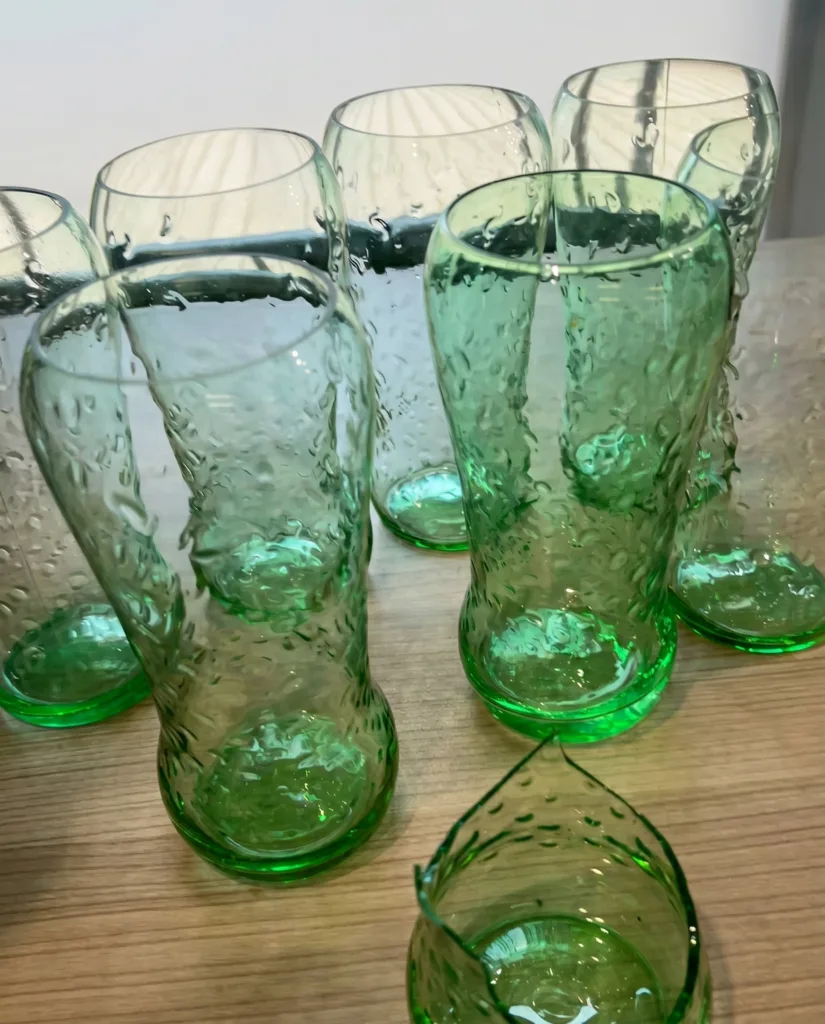
In mass-colored (through-colored) glass, color is the result of an entire production system.
What you see is influenced by:
- colorants and base glass composition
- melting temperature and temperature curves
- melting time and heat history
- furnace stability
- glass thickness
- lighting conditions used for evaluation
Because all of these variables interact, small adjustments rarely affect only one aspect of color.
A change intended to reduce “green” may also influence:
- hue
- saturation
- transparency
- how the color appears under different lighting conditions
This is why percentage-based instructions often create confusion during sampling.
Why Factories Clean the Pot—And Color Can Still Shift
Before every new color production run, factories clean the pot (crucible) as thoroughly as possible to minimize cross-contamination.
However, glass color is highly sensitive. Even after cleaning, factors such as:
- micro-residue
- furnace conditions
- melt history
- temperature fluctuations
can still influence the next batch.
A useful way to think about it is this:
Cleaning reduces carry-over. It doesn’t eliminate physics.
This does not mean the process is uncontrolled.
It means color consistency depends on the entire melting system—not just the recipe itself.
For certain greens, ambers, and more complex shades, these effects become more noticeable.
MOQ Is Usually Tied to One Melt—Not One SKU
One of the most common sourcing misunderstandings concerns MOQ.
In many mass-colored glass projects, MOQ is not determined by the individual product.
It is determined by the capacity of a single melt.
That creates an important sourcing advantage:
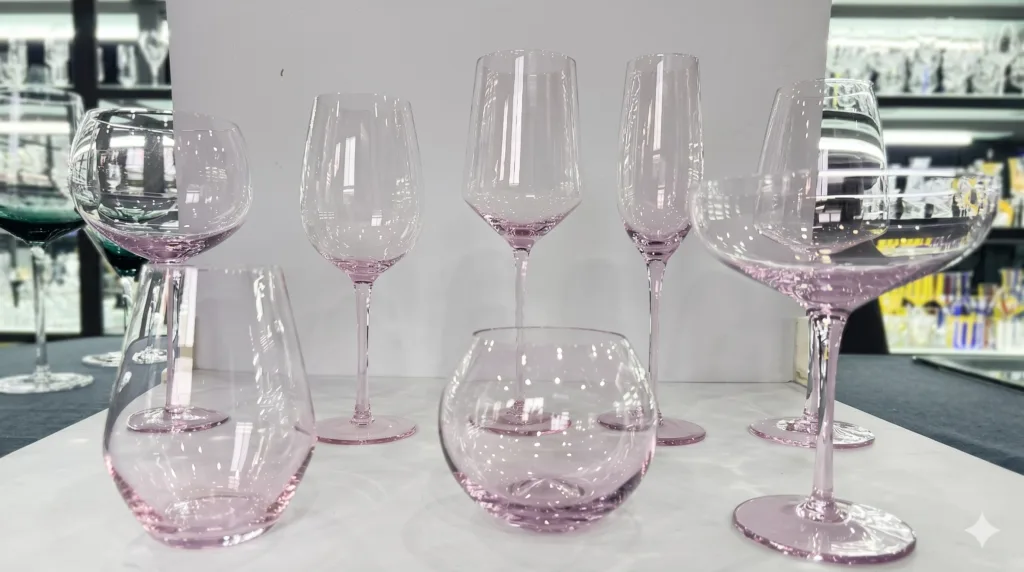
- tumblers, goblets, and carafes can often be produced together
- multiple SKUs can share the same production run
- as long as they use the same color batch
In practice, the color batch—not the individual SKU—is often the real production unit.
Rule of thumb: one color = one melt.
When a collection requires multiple colors, additional melts are typically required, increasing MOQ, scheduling complexity, and approval work.
Why the Same Recipe Doesn’t Guarantee the Same Color
Even when the same color formula is used, slight differences can still occur due to:
- raw material variation
- furnace temperature curves
- melting time
- heat history
- glass thickness distribution
- lighting conditions during evaluation
For this reason, “100% identical color” is rarely a realistic production objective.
A more practical goal is consistency within an agreed acceptance range.
The most successful projects focus on defining that range early.
What Buyers Should Request Instead of “5% Less Green”
Once procurement teams understand that color is a system rather than a fixed number, the conversation changes.
The goal is no longer to find the perfect percentage adjustment.
The goal is to create a repeatable approval standard that both buyer and supplier can evaluate consistently.
That shift alone can eliminate weeks of unnecessary sampling.
The fastest projects are usually not the ones with the most detailed color formulas.
They are the ones with the clearest visual targets.
A Quick Buyer Checklist
- Reference sample (or Pantone + lighting context)
- Acceptance window (e.g., “slightly less green, keep transparency”)
- Golden sample (the standard everyone compares against)
- Same-batch production plan (when consistency is critical)
1) Provide a Physical Reference Sample
A physical reference remains the most effective communication tool.
It gives both buyer and supplier the same visual target and removes unnecessary interpretation.
2) Define the Desired Outcome
Instead of specifying percentages, describe the result you want.
For example:
- slightly less green while maintaining transparency
- maintain hue but reduce saturation
- appear cleaner under warm indoor lighting
These instructions are much easier for production teams to execute.
3) Approve a Golden Sample
Once the target is achieved, approve a production reference sample.
Future batches can then be compared against a shared standard rather than individual opinions.
4) Use Controlled Options
Rather than endless revisions, request two or three controlled sample variations and select the closest match.
This creates a faster and more repeatable approval process.
A Practical Workflow for Faster Color Approval
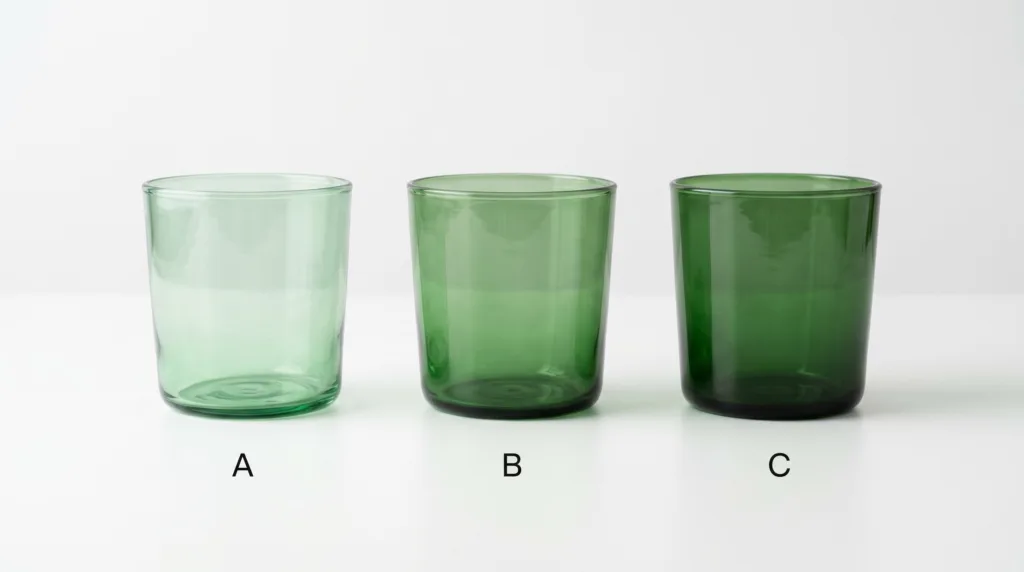
For procurement and product teams, the following workflow often reduces sampling rounds significantly:
- Provide a physical reference sample or visual target
- Define evaluation lighting conditions
- Confirm MOQ and melt constraints
- Review 2–3 controlled color options
- Approve a golden sample
- Reserve same-batch inventory when consistency is critical
This approach focuses on decision-making rather than endless color adjustments.
Final Thought: A Repeatable Visual Standard Beats a “Perfect Percentage”
In mass-colored glass, the goal is rarely to find the perfect percentage adjustment.
The goal is to establish a Repeatable Visual Standard that both buyer and manufacturer can evaluate consistently across production runs, lighting conditions, and product thickness.
A Repeatable Visual Standard consists of:
- a reference sample
- lighting conditions
- thickness context
- an agreed acceptance window
The projects that move fastest are usually not the ones with the most detailed color instructions.
They are the ones with the clearest reference, the clearest acceptance criteria, and the clearest approval process.
Because in glassmaking, successful color development is rarely about finding the perfect formula.
It is about defining a Repeatable Visual Standard before production begins.