The question we hear more often than you’d think
A client once asked us during a handmade glassware sampling and development project:
“We usually expect continuous improvement from one iteration to the next. Why does the latest prototype seem worse in some areas than the previous one?”
It was a fair question.
Because the unspoken assumption is: a new version = a better version.
That logic works beautifully in software.
Handmade glassware doesn’t play by that rule.
In handmade sampling, every “small tweak” is rarely small. It’s usually a shift in the entire production balance—and balance is exactly what decides whether your final product will be stable in real orders.
Handmade sampling isn’t a staircase. It’s a tightrope.
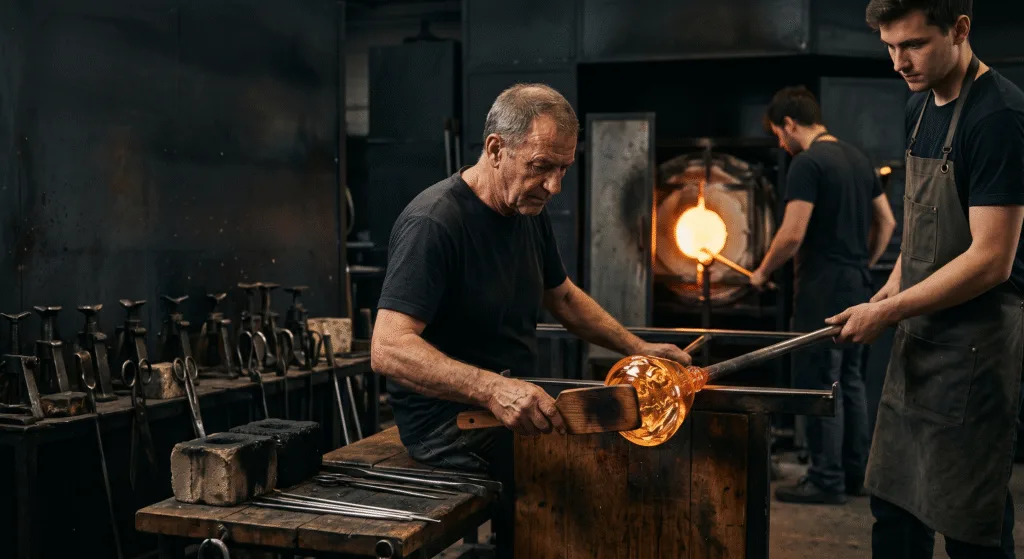
On this project, we weren’t adjusting one variable. We were stacking and balancing multiple handmade processes, such as:
- handblown shaping
- spray color
- decal application
- multiple finishing steps
When those layers interact, changes compound. That’s why a newer sample can be closer to your target in one area and less stable in another—at the same time.
Progress in handmade is often:
better here, harder there.
One more adjustment” is where trade-offs quietly enter
Here are a few real-world examples buyers don’t always see at the sample stage:
Thinner rim
Can look more elegant in a photo, but may reduce stability during production and increase breakage risk.
Cleaner surface
Can improve appearance, but may lower yield (higher rejection rate) once you run at normal speed.
Added decoration
(decal, gilding, multi-step finishing)
Can add brand impact, but may introduce stress points during production, shipping, and hospitality use.
Color adjustment
(especially in colored glass)
Color in handmade glass is material- and furnace-dependent—not a Pantone-style “dial-in” system. A tweak can improve matching while making batch-to-batch consistency harder to control.
So yes: sometimes you improve one detail and unintentionally destabilize another part of the production balance.
That’s not “getting worse.”
That’s trade-off management—the real work of manufacturing.
Why the best-looking sample can be the least repeatable
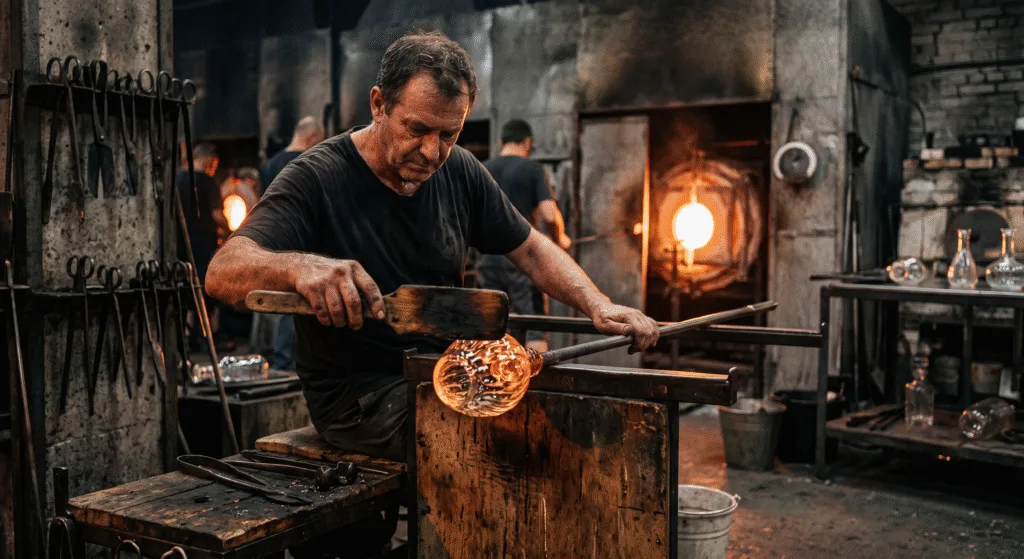
This is one of the biggest challenges in handmade glassware sampling for hospitality and designer-led projects.
A sample can look amazing because it was:
- individually adjusted
- produced at a slower pace
- handled by the most experienced craftsperson
- made with unusually high rejection tolerance
But real orders require:
- repeatability across people and shifts
- manageable yield
- stable results across batches
- lead-time and process control
- durability in transport and real hospitality use
In other words: a perfect sample can be a fragile solution if it can’t survive the realities of production.
The buyer-friendly framework that prevents sampling loops
The projects that run smoothly don’t chase endless micro-adjustments. They define “success” early:
1) Lock the non-negotiables
What must be true no matter what?
Examples: silhouette, capacity range, rim feel, key brand detail, hospitality functionality.
2) Define acceptable variation vs. defects
What belongs to handmade character—and what is a true defect for your market positioning and use scenario?
3) Validate production feasibility early
Before polishing cosmetics, confirm what can realistically stay stable at your required:
- volume
- lead time
- durability level
- consistency standard
When these are clear, sampling becomes faster—and surprises become rare.
What to include in your inquiry (so sampling moves faster)
If you’re developing handmade glassware for hospitality, retail, or designer-led collections, sending the right inputs early can dramatically reduce unnecessary rounds.
Include:
- reference photos/drawings (front/side/top)
- target dimensions + capacity
- intended use scenario (dishwasher, stacking, high-turn service, gifting, etc.)
- decoration requirements (spray color, decal, gold rim, etching, etc.)
- market positioning + durability expectation
- estimated annual volume + target lead time
- your top 3 non-negotiables—and where flexibility is acceptable
The goal isn’t the most perfect-looking sample.
It’s the most repeatable product.
About Eukaglass
Eukaglass works with hospitality brands, designers, and sourcing teams on handmade glassware development—focused on manufacturability, repeatability, and long-term production consistency.